/p/, /pʰ/as in pen
You likely press your lips together and release with only a light puff of air, the same way you make Hungarian p in every position, without adding extra aspiration at the start of stressed syllables.
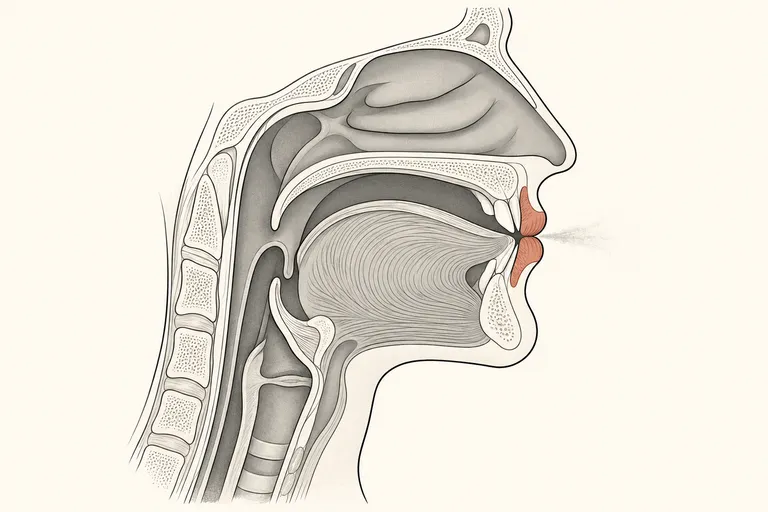
What you probably do
You likely press your lips together and release with only a light puff of air, the same way you make Hungarian p in every position, without adding extra aspiration at the start of stressed syllables.
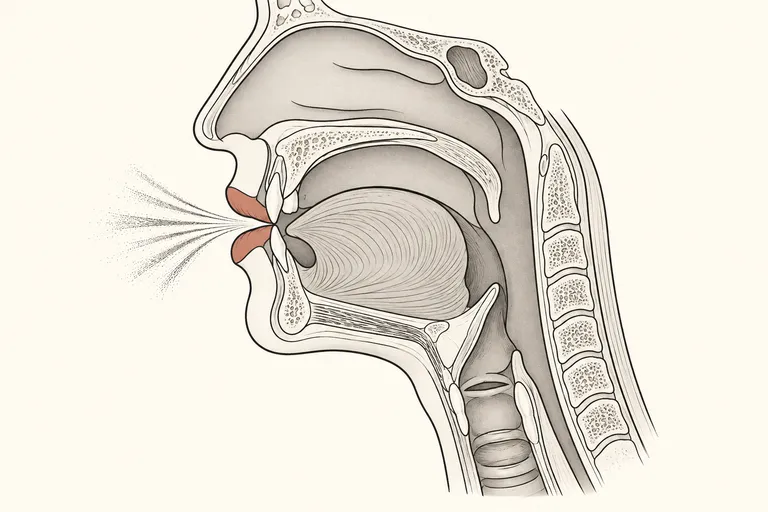
How natives do it
Americans press the lips together to fully block the air, then release with a noticeable burst right after — hold a tissue in front of your mouth and it should flutter — especially at the start of stressed words like 'pen'. After 's', as in 'spin', the aspiration disappears again.
Why it matters
Because English listeners use this puff of air as a key cue for telling p from b, an unaspirated p can make 'pin' sound like 'bin' even though your lip movement is otherwise correct. Adding a clear burst of air at stressed syllable onsets prevents this specific, well-documented confusion.
Hear the difference
Words this touches
Hungarian speakers often substitute /p/.
How the mouth differs
Hungarian p is a voiceless bilabial stop with a short voice onset time (roughly 10-20ms), produced with minimal aspiration in all positions. English p is strongly aspirated (VOT often 60-100ms) at the start of a stressed syllable, though it loses aspiration after s ('spin') and may be unreleased in coda position.
Listen for the pattern
Because English relies heavily on the aspiration burst, not just voicing, to distinguish p from b at syllable onset, an unaspirated Hungarian-style p in a word like 'pen' can be misheard by American listeners as the voiced counterpart 'ben'.
Reader ratings and feedback are coming soon.
Sources (2)
- Prof John C. Wells_Workshop: Questions and Answers onEnglish...
- The content identifies core phonetic features relevant to accent analysis, including tonal patterns (High Fall, Fall-Rise) and articulatory phenomena (aspiration, clipping, glottal stop).
- It references John C. Wells' 'Accents of English' as the primary theoretical source for understanding English accent variation.
- The material targets early English teaching and learning contexts by highlighting specific tonicity and syllabification rules.
- Wells, J.C. (1982). Accents of English.