/ʒ/as in vision
You likely replace this sound with your native 'sh' (voiceless), since Mandarin has no voiced postalveolar fricative and this is the closest sound already in your inventory, especially since this sound is uncommon and…

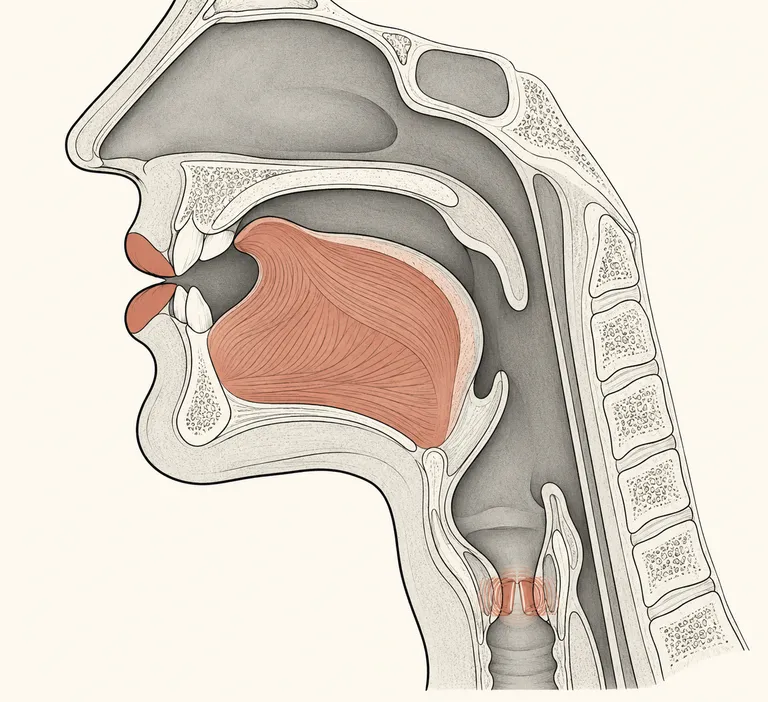
What you probably do
You likely replace this sound with your native 'sh' (voiceless), since Mandarin has no voiced postalveolar fricative and this is the closest sound already in your inventory, especially since this sound is uncommon and often buried in the middle of English words.
How natives do it
Native speakers shape the tongue and lips exactly as for 'sh' — bunched tongue, rounded lips — but keep the vocal folds vibrating throughout, adding a steady buzz to the hush rather than leaving it voiceless, as in the middle of 'measure' or 'vision'.
Why it matters
Because this sound is rare and usually mid-word, devoicing it rarely causes confusion, but adding the voicing will make words like 'vision', 'measure', and 'treasure' sound noticeably more natural and will sharpen subtle distinctions like 'rouge' versus 'ruse'.
Hear the difference
Words this touches
Mandarin Chinese speakers often substitute /ʃ, z/.
How the mouth differs
Mandarin has no voiced postalveolar fricative at all, and this sound is already rare even within English, appearing mostly in borrowed or mid-word positions. Learners typically devoice it to the much more familiar ʃ, or occasionally substitute /z/, since neither captures the specific combination of postalveolar place and voicing.
Listen for the pattern
Because ʒ is genuinely rare in English and often buried mid-word, substituting ʃ rarely causes outright confusion, but it does flatten a subtle voicing distinction that careful or minimal-pair listening relies on, as in 'rouge' versus 'ruse'.
Reader ratings and feedback are coming soon.
Sources (2)
- Exploring Phonetic Differences and Cross-Linguistic Influences: A Comparative Study of English and Mandarin Chinese Pronunciation Patterns — 2024
- Mandarin speakers frequently substitute non-existent English sounds like /θ/ and /ð/ with /s/ or /z/, and struggle with voiced consonants due to lack of corresponding phonemes in their native system.
- English speakers often confuse Mandarin tones (particularly 2nd and 3rd) and mispronounce back vowels because English lacks a tonal structure and specific vowel inventory.
- Approximately 70% of surveyed learners identified phoneme differences as the main barrier to effective pronunciation in their target language.
- Wells, J.C. (1982). Accents of English.