/ɛ/as in bed
You produce ɛ correctly in quality but give it the same clipped, even length in every word, since Hungarian vowel length is fixed by the word itself, not by neighboring sounds.

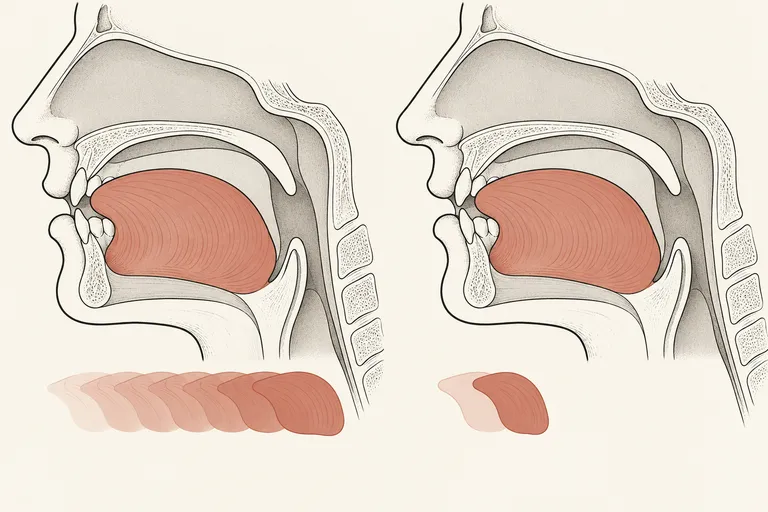
What you probably do
You produce ɛ correctly in quality but give it the same clipped, even length in every word, since Hungarian vowel length is fixed by the word itself, not by neighboring sounds. This means 'bed' and 'bet' may come out with nearly identical vowel timing.
How natives do it
Americans automatically lengthen ɛ before voiced consonants like d, b, g, v, z and keep it short before voiceless ones like t, p, k, f, s. This durational shift happens without conscious effort and helps signal whether the final consonant is voiced.
Why it matters
Because English listeners partly judge word-final voicing by vowel length rather than the consonant alone, a flat vowel duration can make 'bed' sound uncomfortably close to 'bet.' Practicing the stretch-before-voiced pattern sharpens this subtle but real cue.
Hear the difference
Words this touches
Hungarian speakers often substitute /ɛ/.
How the mouth differs
Hungarian ɛ is a stable, unglided mid-low front vowel much like English ɛ in quality, but Hungarian treats vowel length as a fixed lexical property rather than a positional cue. English lengthens ɛ noticeably before voiced codas ('bed') and shortens it before voiceless ones ('bet'); Hungarian speakers tend to give ɛ a flat, invariant duration regardless of what follows.
Listen for the pattern
Native listeners barely notice the vowel quality itself but may perceive the coda consonant as less clearly voiced or voiceless, since English speakers partly rely on vowel length to judge that distinction.
Reader ratings and feedback are coming soon.
Sources (1)
- An Optimality Theoretic account ofHungarianESLlearners...
- Hungarian ESL learners transfer the contrastive nature of vowel length from L1 to L2 despite it being non-functional in standard English.
- Optimality Theory successfully models these interference patterns by ranking constraints that prioritize L1 phonological habits over L2 requirements.
- Learners exhibit difficulty suppressing Hungarian-specific phonological rules when producing English words with short vowels.