/b/as in bed
Following your Spanish habit, you probably let 'b' soften into a loose, barely-touching lip approximant whenever it appears between vowels, as in 'about' or 'rabbit', letting some air continue to flow through instead of…
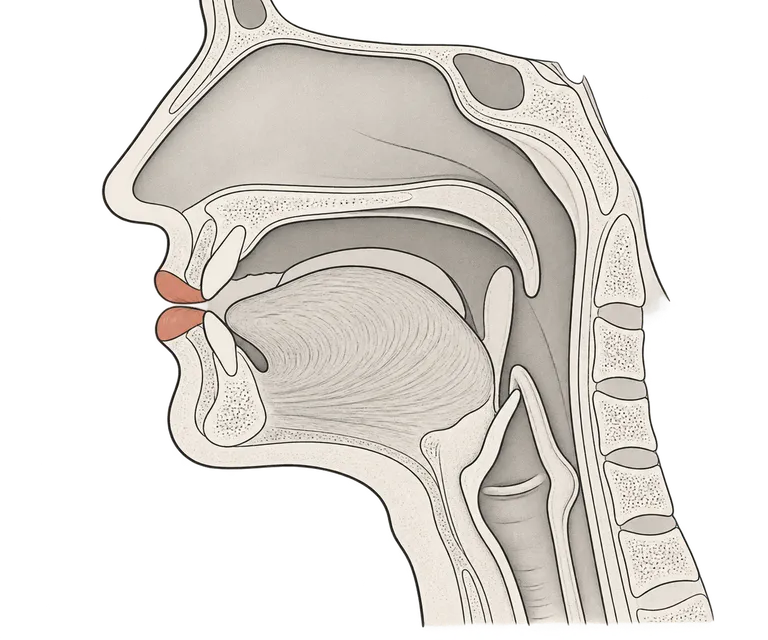
What you probably do
Following your Spanish habit, you probably let 'b' soften into a loose, barely-touching lip approximant whenever it appears between vowels, as in 'about' or 'rabbit', letting some air continue to flow through instead of fully sealing your lips shut.
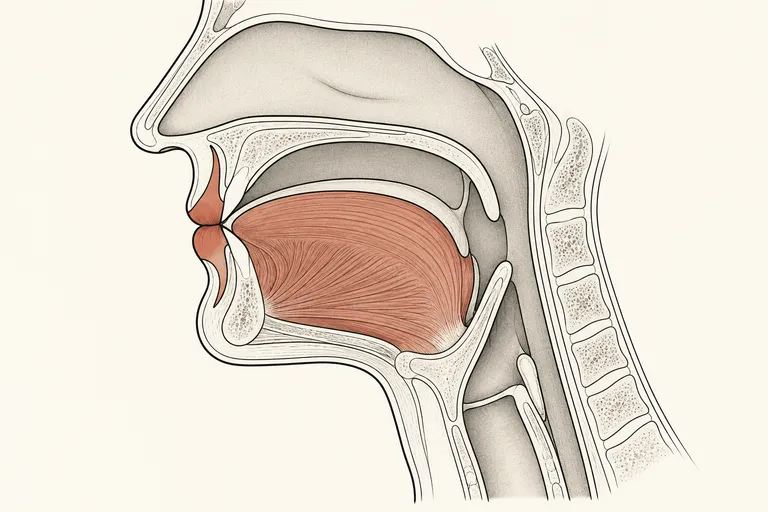
How natives do it
Americans keep a complete, firm lip closure for 'b' in every position, including between vowels, briefly stopping all airflow before releasing with voicing throughout — there is no equivalent softening or approximant version in English, unlike in Spanish.
Why it matters
A weakened, approximant-like 'b' can sound mumbled or, in some cases, drift close enough to 'v' to cause real confusion, since English relies on a clear stop-versus-fricative distinction between these two sounds that Spanish does not maintain in the same positions.
Hear the difference
Words this touches
Spanish speakers often substitute /b, β/.
How the mouth differs
Spanish b is a full stop only after a pause or nasal; between vowels and after most continuants it lenites to a soft bilabial approximant with the lips barely touching, letting air pass through. American English b remains a true stop with full lip closure in every position, including between vowels, as in 'rabbit' or 'about'.
Listen for the pattern
Carrying the Spanish lenition habit into English can make intervocalic b sound weak, breathy, or even confusably close to v to American listeners, since English distinguishes b and v partly by degree of lip closure, which Spanish speakers may under-produce between vowels.
Reader ratings and feedback are coming soon.
Sources (2)
- Lenition in L2 Spanish: The Impact of Study Abroad on Phonological Acquisition. — Ratree Wayland, Rachel Meyer, Sophia Vellozzi et al., 2024
- Learners demonstrated progress in producing fricative-like variants of Spanish voiced stops during the study abroad program.
- Phonological gains made during immersion were not retained after learners returned to their home environment.
- Unlike native speakers, L2 learners never fully achieved approximant-like realizations of lenition regardless of exposure duration.
- Wells, J.C. (1982). Accents of English.