Aspiration
In Spanish, p, t, and k are always produced without any puff of air, whether at the start of a word or anywhere else — there's no contrast that depends on aspiration, only on voicing.
What you probably do
In Spanish, p, t, and k are always produced without any puff of air, whether at the start of a word or anywhere else — there's no contrast that depends on aspiration, only on voicing. Carrying this habit into English, you likely pronounce words like 'pie', 'tie', and 'kite' with a soft, unaspirated consonant, closer to how you would say them in 'pan', 'tango', or 'casa'.
How natives do it
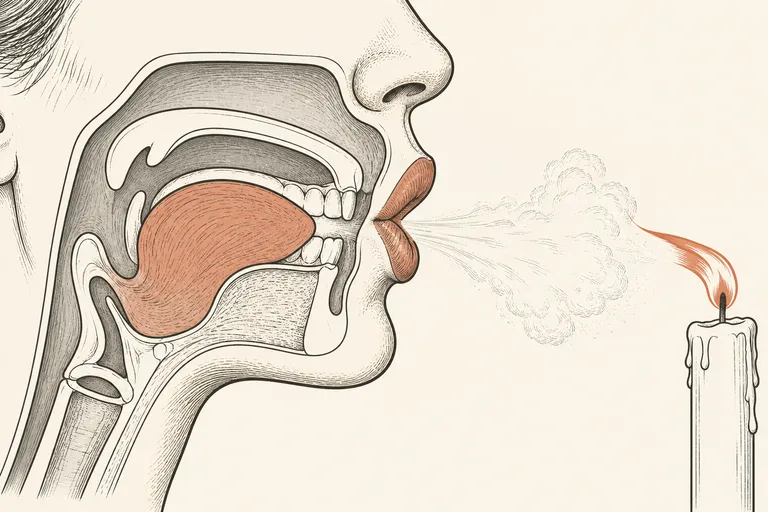
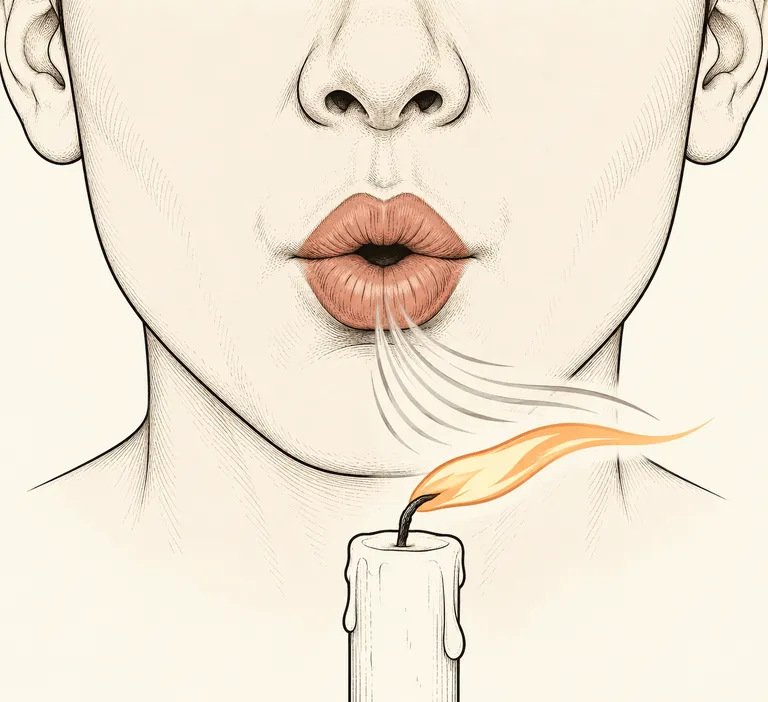
At the start of a stressed syllable, American English speakers release p, t, and k with a strong burst of air; hold a tissue near your mouth and it should visibly move. This aspiration is actually the main cue English listeners use to tell 'pie' from 'bye', 'tie' from 'die', and 'kite' from a word starting with g, even more than whether the vocal cords are vibrating.
Why it matters
Without that puff of air, your voiceless p, t, k can be misheard by native English listeners as the voiced b, d, g, since aspiration, not just voicing, signals the difference in English. This can cause real confusion between pairs like 'pie' and 'bye', even when everything else is clear. Adding a crisp puff of air to stressed initial p, t, and k is one of the highest-impact, easiest fixes available to a Spanish-speaking learner.
How the mouth differs
English voiceless stops p, t, k are produced with long-lag voice onset time, a strong 40 to 100 millisecond puff of air, at the start of stressed syllables, whereas Spanish p, t, k are always short-lag and unaspirated regardless of stress or position, since Spanish relies purely on a voicing contrast rather than aspiration to separate its stop consonants.
Listen for the pattern
Because English listeners use aspiration, not voicing, as the primary cue for the p-b, t-d, k-g distinctions in stressed syllable onsets, unaspirated Spanish-style stops are frequently misheard as their voiced counterparts, creating real word-level confusion rather than just an accent flavor.
Try these sentences
- Peter paid for the pizza.stressed initial p in 'Peter', 'paid', 'pizza' needs a strong puff of air; unaspirated Spanish-style p can sound like b
- Tom took two tickets.initial t sounds need aspiration in stressed position; without it, 'Tom' may be heard as 'Dom'
- Can you come to the park?stressed initial k in 'come', 'park' requires aspiration; unaspirated versions can be perceived as g
Reader ratings and feedback are coming soon.
Sources (2)
- Hualde, J.I. (2005). The Sounds of Spanish. Cambridge University Press.
- Wells, J.C. (1982). Accents of English.