This is an AI-generated research project, still being refined. It may contain errors. Reader ratings and feedback are coming soon. How this is made
For Hindi (Modern Standard Hindi) speakers
Your English has a Hindi (Modern Standard Hindi) shape. Here is
where.
When Hindi is spoken, the mouth tends to stay fairly steady: the jaw doesn't drop as much as in English, and the lips stay fairly relaxed rather than spreading wide for smiles-shaped vowels. The tongue does a lot of its work right at or near the teeth, and sometimes curls back further than English speakers are used to, which gives certain consonants a crisper, more percussive feel.
The Hindi (Modern Standard Hindi) comparison is being researched. Daily tips are available.
Rest positionNeutral face at rest: lips gently closed, jaw relaxed, tongue tip resting near the upper front teeth.
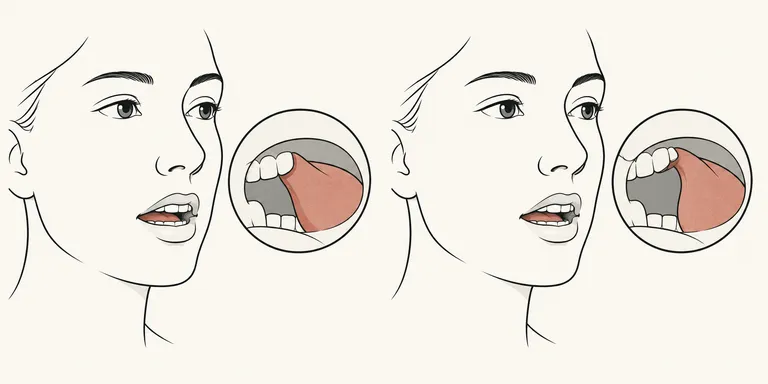
Dental vs. retroflex contactTwo tongue placements shown side by side: tongue tip against the upper teeth for a dental sound, and tongue tip curled back toward the hard palate for a retroflex sound.
Hindi speakers frequently place the tongue right against the teeth (dental) or curl it back (retroflex), positions between or beyond where English places its 't' and 'd' sounds; nasalized vowels add a light nasal quality to the voice.
How Hindi (Modern Standard Hindi) moves
sourced
Hindi tends to give each syllable a more equal amount of time and clarity, rather than squeezing unstressed syllables the way English does. This can make Hindi-accented English sound more evenly paced, syllable by syllable, instead of speeding through weak syllables and stretching out the stressed ones, which is the heartbeat of natural American rhythm.
Where Hindi (Modern Standard Hindi) rests
sourced
When Hindi is spoken, the mouth tends to stay fairly steady: the jaw doesn't drop as much as in English, and the lips stay fairly relaxed rather than spreading wide for smiles-shaped vowels. The tongue does a lot of its work right at or near the teeth, and sometimes curls back further than English speakers are used to, which gives certain consonants a crisper, more percussive feel. Because some vowels are nasalized, air escapes through the nose a bit more often, adding a light nasal color to the voice. Overall, articulation feels slightly tighter and more forward in the mouth than the loose, rounded-back setting typical of American English, and unstressed syllables keep more of their full vowel color instead of melting into a quick 'uh' sound.
Modern Standard Hindi (Khariboli-based, Delhi standard); notes apply broadly to educated Hindi across North India and inform common patterns in Hindi-influenced Indian English.